As global populations rise and cities become increasingly dense, the demand for sustainable and resilient food systems continues to intensify. Vertical farming has emerged as a groundbreaking solution that reimagines agricultural production within the constraints of modern urban landscapes. By stacking crops in climate-controlled indoor environments, vertical farms maximize space efficiency, reduce resource consumption, and strengthen local food networks. This innovative approach is transforming urban agriculture and offering new pathways to enhance global and community-level food security.
Unlike traditional farming, vertical farming is not reliant on fertile soil, predictable weather, or large-scale land availability. Instead, it uses advanced technologies—such as LED lighting, hydroponics, aeroponics, and automated nutrient delivery—to grow fresh produce year-round. As cities face increasing supply-chain vulnerabilities, energy constraints, and environmental challenges, vertical farming presents a resilient model capable of supporting sustainable food production right where people live.
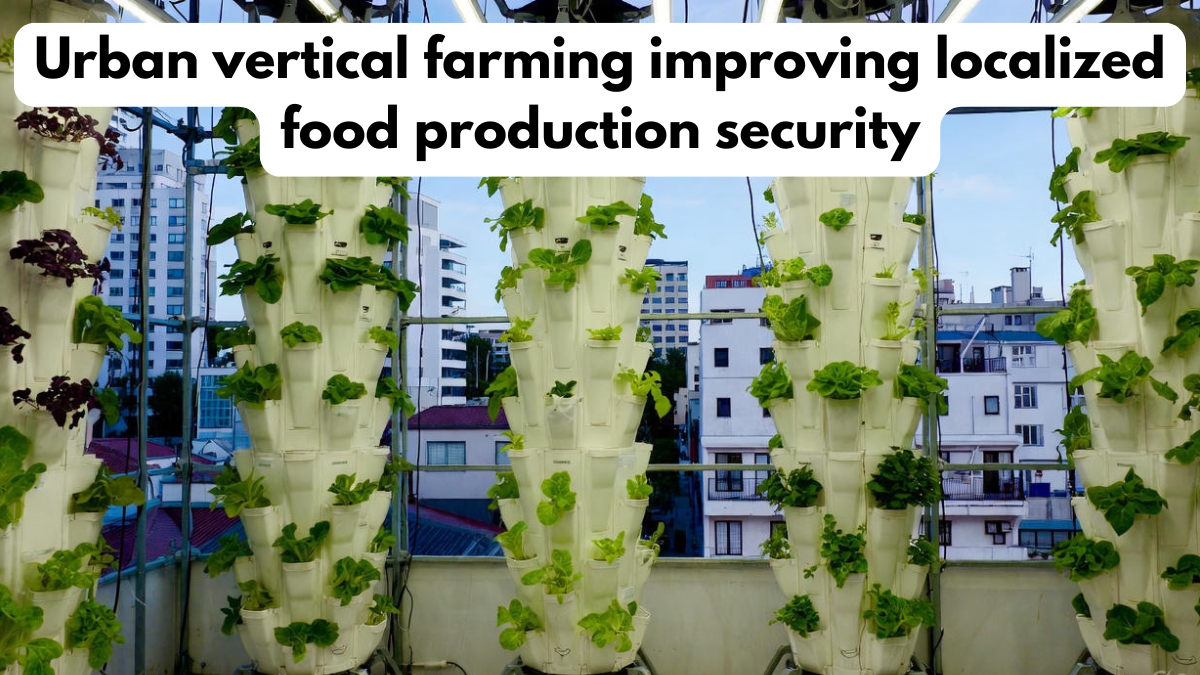
Why Vertical Farming Is Transforming Urban Agriculture
Vertical farming has revolutionized how cities think about food production. Traditional agriculture often requires vast land areas, substantial water resources, and consistent climate conditions. In contrast, vertical systems leverage technology to create controlled environments capable of producing high yields in minimal space.
By integrating vertical farming into urban agriculture, cities can grow fresh produce closer to consumers, reducing transportation costs, carbon emissions, and food loss. This improves supply-chain efficiency while supporting local economies and community resilience.
Furthermore, vertical farms operate independently of seasonal variations, ensuring consistent availability of leafy greens, herbs, vegetables, and specialty crops. This reliability contributes significantly to food security, particularly in regions prone to extreme weather, resource shortages, or geopolitical instability.
Major Technologies Powering Vertical Farming
Vertical farms rely on sophisticated systems that regulate environmental variables to optimize plant growth. These technologies increase efficiency and sustainability, making them essential to modern urban agriculture.
The table below outlines key technologies used in vertical farming and their contributions to improved food security:
| Technology | Description | Impact on Urban Agriculture & Food Security |
|---|---|---|
| Hydroponics | Soil-free growing using nutrient-rich water solutions | Reduces water use by up to 90% and enhances crop yield |
| Aeroponics | Roots are suspended in air and misted with nutrients | Promotes rapid growth and reduces disease risk |
| LED Grow Lights | Artificial lighting tailored to plant needs | Enables year-round production and reduces energy waste |
| Automated Monitoring Systems | Sensors regulate temperature, humidity, and nutrients | Optimizes plant health and minimizes labor requirements |
| Vertical Racks & Modular Designs | Space-efficient systems for stacking crops | Maximizes food output in urban environments |
These technologies work together to support sustainable farming practices and improve long-term production capacity in cities.
Environmental and Economic Advantages
One of the most significant benefits of vertical farming is its low environmental footprint. Traditional agriculture often involves heavy pesticide use, soil degradation, and high water consumption. In contrast, vertical farms use controlled environments that reduce or eliminate the need for pesticides, dramatically cut water usage, and prevent soil depletion.
From an economic standpoint, integrating vertical farming into urban agriculture can stimulate job creation in areas such as farm management, engineering, automation, logistics, and agricultural research. It also reduces transportation costs because food is grown closer to consumers, ensuring fresher products with longer shelf lives.
Vertical farming also strengthens food security by shortening supply chains. During crises—such as natural disasters, pandemics, or trade disruptions—localized food production ensures stable supply and reduces dependence on distant producers. This resilience is essential in global cities where food imports significantly outweigh local production capacity.
Challenges Limiting Large-Scale Adoption
Despite its advantages, vertical farming faces several challenges that slow widespread adoption. The initial capital investment required for building controlled-environment farms remains high. Equipment such as LED lighting systems, climate-control machines, and automated technologies can be costly, especially for small-scale producers.
Energy consumption is another concern. While LED technology has become more efficient, maintaining indoor farms still requires significant electricity use. To fully support sustainable urban agriculture, vertical farms must increasingly integrate renewable energy sources such as solar, wind, or green hydrogen.
Additionally, vertical farming is best suited for high-value crops like leafy greens and herbs. Staple crops—such as wheat, rice, and corn—are less economically viable in vertical environments due to their size and growth cycles. This limitation affects the technology’s overall impact on global food security, although research continues to expand viable crop varieties.
Labor skill gaps also pose challenges. Operating advanced farming systems requires expertise in horticulture, engineering, and data analytics. Addressing skill shortages is crucial for the expansion of vertical farming industries worldwide.
Vertical Farming and the Future of Food Security
The future of food security will depend heavily on localized, technologically driven food production methods. Vertical farming complements traditional agriculture by offering reliable, sustainable, and flexible solutions capable of supporting growing urban populations. As climate change intensifies droughts, floods, and soil degradation, vertical farms will become increasingly important buffers against agricultural disruptions.
Global investment in urban agriculture is accelerating. Governments, private developers, and tech companies are establishing vertical farms in cities such as Singapore, Tokyo, Dubai, London, and New York. These initiatives aim to reduce dependence on imports, support self-sufficiency, and promote environmentally friendly food production.
Continued advancements in automation, renewable energy integration, and crop science will further strengthen vertical farming’s role. As costs decrease and technology becomes more accessible, cities worldwide will rely more heavily on vertical systems to secure food supplies and reduce environmental impact.
Conclusion
Vertical farming represents a transformative shift in agricultural innovation, offering sustainable, efficient, and resilient solutions for modern cities. By expanding urban agriculture and integrating advanced technologies, vertical farming supports consistent production, reduces environmental strain, and enhances global food security. While challenges remain—such as high energy use, initial costs, and crop limitations—ongoing innovation and investment continue to strengthen its potential. As cities plan for a more sustainable future, vertical farming will play a central role in shaping resilient food systems capable of meeting the demands of growing populations.
FAQ
How does vertical farming support food security?
It produces fresh, reliable crops year-round, reducing dependence on external supply chains.
What technologies enable vertical farming?
Hydroponics, aeroponics, LED lighting, automation, and modular vertical structures.
Why is vertical farming important for urban agriculture?
It maximizes space efficiency and brings food production directly into cities.
What challenges limit vertical farming growth?
High initial costs, energy consumption, crop-type limitations, and skill shortages.
Can vertical farming replace traditional agriculture?
It complements rather than replaces traditional methods, especially for high-value crops and urban food resilience.
Click here to learn more