As global disasters become more frequent, the need for innovative emergency food solutions is greater than ever. Traditional supplies such as canned goods, protein bars, and powdered meals have served crisis zones for decades, but they often fall short in terms of portability, nutrition, and long-term sustainability. This is where microbial foams enter the picture—an emerging food technology that uses microbial fermentation to produce lightweight, nutrient-rich edible foams. Designed to be durable, quick to produce, and adaptable to a wide range of climates, microbial foams may soon redefine how humanitarian organizations deliver life-saving nutrition.
Unlike standard stored foods, microbial foams can be engineered to contain essential vitamins, proteins, probiotics, and carbohydrates. Their airy, porous structure makes them extremely light, allowing large quantities to be transported rapidly to disaster areas. As the world continues to face natural calamities, conflict-driven displacement, and food insecurity, microbial foams offer a promising pathway toward sustainable and efficient emergency food distribution.
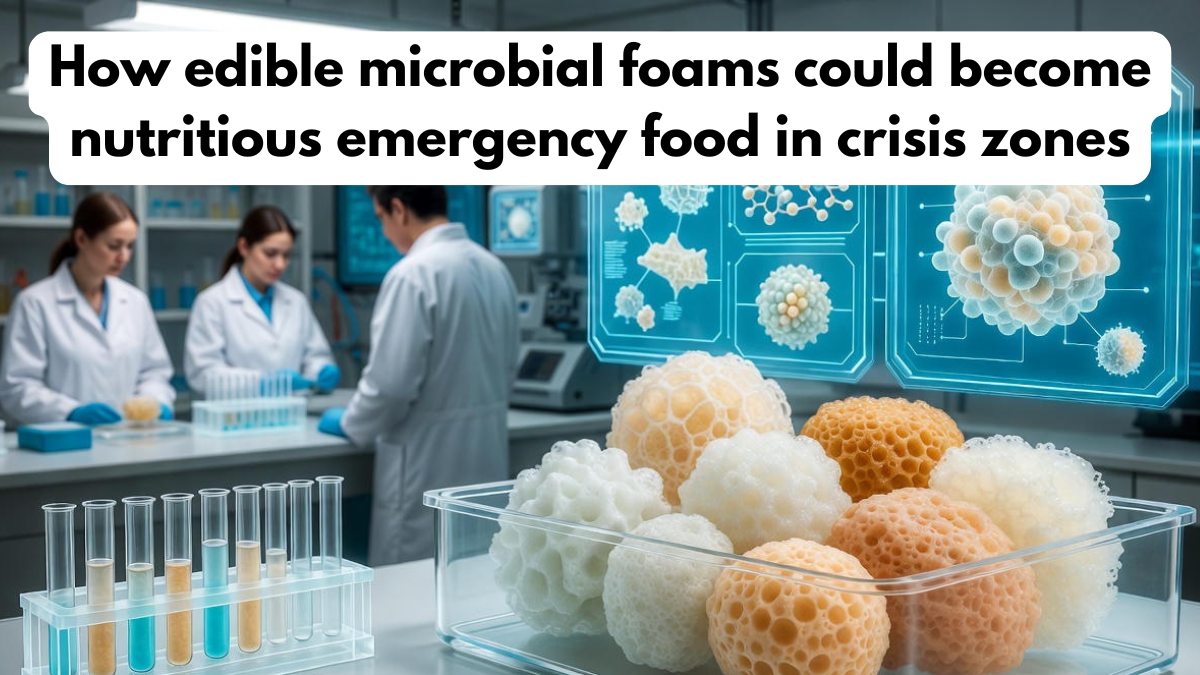
Why Microbial Foams Are a Breakthrough in Emergency Nutrition
The science behind microbial foams relies on cultivating specific microorganisms—such as yeasts, fungi, or bacteria—that produce edible proteins and fibers during fermentation. When aerated, these materials transform into stable, foam-like structures. This process is much faster and more resource-efficient than growing crops or raising livestock, making it ideal for regions where land and water scarcity hinder food production.
Their potential makes them especially valuable as emergency food, where the priority is rapid deployment and reliable nutrition. Microbial foams can be manufactured in controlled facilities using minimal raw materials, ensuring consistent quality. They also offer longer shelf life and greater resilience against temperature shifts compared to traditional perishable foods, making them suitable for unpredictable crisis environments.
Benefits of Using Microbial Foams in Crisis Zones
By integrating microbial foams into relief strategies, aid organizations can significantly improve the speed, safety, and efficiency of their food delivery programs. Their lightweight constitution reduces shipping weight, while their structured design allows for easy packing and distribution. In comparison with many standard emergency rations, microbial foams can be tailored to meet specific nutritional needs, including high-protein formulas for malnourished populations or vitamin-enriched versions for children and the elderly.
Key advantages include:
- Extremely lightweight and easy to transport
- Customizable nutrient profiles
- Faster production compared to agriculture
- Long shelf life suitable for emergency food storage
- Resilient under extreme temperatures
- Easily digestible and appropriate for a wide range of diets
These benefits highlight why microbial foams are considered one of the most promising advancements in humanitarian nutrition.
Table: Comparison of Microbial Foams and Traditional Emergency Food
| Feature | Microbial Foams | Traditional Emergency Food |
|---|---|---|
| Production Speed | Very fast; fermentation-based | Slow; reliant on farming and processing |
| Nutritional Flexibility | Highly customizable | Limited |
| Transportation Weight | Very low | Moderate to heavy |
| Shelf Life | Long, stable | Varies; often shorter |
| Suitability for Crisis Zones | Excellent | Good but limited by supply chains |
This comparison demonstrates how microbial foams outperform standard options in delivering consistent, reliable emergency food during crises.
Global Applications and Future Potential
The adaptability of microbial foams makes them suitable for a variety of humanitarian scenarios, from drought-stricken regions to areas hit by earthquakes or hurricanes. Aid agencies could deploy compact production units capable of manufacturing microbial foams on-site, reducing reliance on long-distance shipping. This decentralization could revolutionize modern disaster relief by providing fresh emergency rations directly where they’re needed most.
In the future, research may expand the flavor profiles and textures of microbial foams, increasing their acceptance among affected populations. Scientists are also exploring ways to enhance foams with medicinal compounds, creating multifunctional emergency food that supports both nutrition and health. As food technology evolves, microbial foams could become an essential component of global crisis-response strategies.
Conclusion
Microbial foams represent a powerful step forward in developing sustainable, efficient, and nutritious emergency food solutions. Their rapid production capabilities, lightweight structure, and customizable nutrient content make them ideal for deployment in disaster zones where traditional food systems fail. As humanitarian organizations continue searching for innovative ways to support vulnerable populations, microbial foams stand out as an accessible and future-ready option that can save countless lives during crises.
FAQs
What are microbial foams?
Microbial foams are edible substances created through microbial fermentation, producing light, nutrient-rich food structures.
Why are microbial foams suitable as emergency food?
They are lightweight, nutritionally customizable, fast to produce, and have a long shelf life, making them ideal for crisis environments.
Can microbial foams be produced on-site during disasters?
Yes, portable production units can be deployed to manufacture microbial foams directly in affected areas.
Are microbial foams safe to eat?
They are made using controlled microbial strains and undergo rigorous safety testing, making them safe for consumption.
Will microbial foams replace traditional emergency rations?
Not entirely, but they offer a powerful and sustainable alternative that enhances existing emergency food systems.
Click here to learn more